The Zodiac
24.2
page 2 of 8
Apparent and functional reality
Apart from the fact that the Earthly or Tropical Zodiac is not a physical belt of stars but a projection cast out from Earth itself (1.2), it now turns out that within that Zodiac, a second projection is going on (24.1): In astrology, we interpret our own position in the firmament as a Solar characteristic, whereas in reality, we have projected that characteristic onto the Sun. This
projecting part of yourself onto your surroundings
is a well-known phenomenon in psychology. And the same goes for its effect: the projection that is being cast out can actually, per reflex, call forth certain events related to that projection (2.1, 23.11). Once again, this shows that something does not necessarily have to be physically present (23.1) in order to have an effect.
Décor
Now, how does this work? Unlike the planetary shells around Earth and the Solar system as a whole, we cannot regard the Zodiac as an energetic field. For the Zodiac is not in fact a field arranged from a Center, but merely a practical measuring instrument designed to locate heavenly bodies in the sky (1.2), as well as an astrological décor for the planets to show themselves to the earthly observer (11.2.a). And for the astrologer, as we know, this décor itself also represents some specific core qualities. But by now, we are well aware of the fact that these core meanings (which Euktemon may have taken from the sidereal Zodiac, but still) have been perpetuated by people as a projection, even though over the centuries, the grounds for it have disappeared from view (1.2). What remained, was merely the projection, cast out from Earth.
Manifesting within a framework
1. This projection turns out to function in such a way that the décor of a certain Zodiacal Sign will either accentuate or blur the core qualities of the various planets.
2. In addition to this, the Zodiac as a whole serves as a twelvefold framework in which a planet’s core quality, passing through those twelve forms of expression, can show itself in all its facets. Implicit in this view is the assumption that the twelve Signs together represent a complete whole. In other words, if the circle of the Zodiac is considered to be a complete whole consisting of twelve parts, then the twelve Signs, in a qualitative sense, provide a complete cycle of revelation for the planets that are projected into it.
Thanks to this circular framework cast out by Man, called the Zodiac, we can not only establish the Ephemerides for all planetary positions, but also their forms of expression in a qualitative sense, based on the circle as a form of revelation (6.1). These are expressed in terms of projected Solar qualities, even though they actually reflect Earth qualities (24.2).
Objective points of suspension
So the Zodiac is a framework cast out by us humans (1.3), which serves as both a quantitative and a qualitative measuring instrument.
The graduation scale of both types of measurement starts with 0° Aries and is further anchored to the four angular points in the Zodiac (15.2). These in turn are related to the four phases of Earth’s orbit around the Sun. In astrology, these four suspension points are known as the Sun’s Solstices and Equinoxes: 0° Aries, 0° Cancer, 0° Libra and 0° Capricorn, where either the Earth’s axis or the Ecliptics plane coincides with the position of the Sun. In daily life, we know these points as the beginning of the seasons: spring, summer, autumn and winter.
These suspension points of the Zodiac are the direct result of the angle of inclination that the Earth’s axis forms with the plane of its orbit around the Sun. These four points are therefore not based on any projection, but on an actual astronomical fact.
In an astrological sense, the Signs on these four angular points together form the Cardinal Cross of the Zodiac. So this Cross has an objective basis in reality.
The Earth’s axis
It now becomes clear that both spheres around Earth are actually called forth by the Earth’s axis:
1. The spherical arrangement around Earth (14.2) follows from the rotation of the Earth’s axis,
2. while the Zodiacal points of suspension follow from the angle of inclination that the Earth’s axis makes with the plane of the Earth’s orbit.
Key position and anchor
In the astrological working model,
the Earth’s rotating axis, with its specific inclination, holds a key position: This I-sayer (16.2) turns out to be the anchor to which we can trace back all astrological core meanings and organically interconnected relationships.
Bearing in mind the perpendicular relationships between analogous (3.1.1 and 3.2 ) realms of reality (9.3), we can now also objectify the cultural zones that we found on our Journey Over the Earth (14.1):
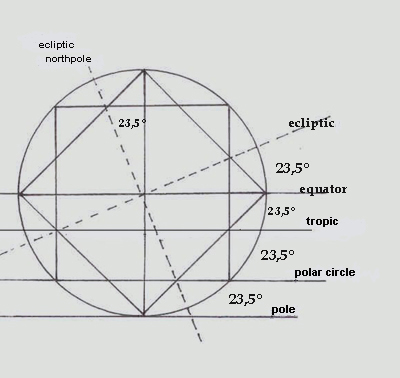
fig.24.2.1 The Earth’s angle of inclination and the culture zones perpendicular to it
For as we can see in the drawing above (fig. 24.2.1), the angle of inclination of the Earth’s axis turns out to correspond with the cultural zones that we encountered before, and this angle also provides the opening into other realms of reality, by way of the Polar circle (15.3).
Exaltation
Finally, it is through the Zodiacal suspension points of the Cardinal Cross that the relationship between the Zodiac and the planets is established, because:
In the four Cardinal Signs of the Zodiac, the three outer planets (18.3), together with the Sun, are in exaltation. Through their mirror and octave function (22.17), all planets take part in this relationship. So in this upper, exalted dimension, the Self with its Self-consciousness is plugged into the Earth’s axis in a qualitative sense.
Now we are getting a picture of an integrated whole, consisting of Man and Earth within the Solar System, functioning wholly as an entity in itself. For a better understanding of the astrological craft, it is of vital importance that we keep in mind
this field of forces that is anchored in itself.
Portals of the Sun
So when we discuss the various facets of Solar qualities, we are actually referring to the different positions that the Earth's axis, in combination with the Sun’s position, takes up throughout the year in relation to its orbit around that Sun.
The four coinciding positions mentioned above can therefore be considered as four cosmic portals through which a specific facet of the Sun, via the entryway of that season (Earth’s axis or Earth’s orbit), can pour into our personal sphere.
Sunrise
From the clarification given here, we may conclude that this continually changing angle of the Earth's axis in relation to the Sun, implies that we are in a permanently evolving relationship with the Sun, which may be felt from month to month or possibly even from day to day:
Through each day’s specific position of the Earth’s axis, the Sun's influence on Earth is being differentiated daily, and with each sunrise, that specific Solar quality finds its way to us.
index, subjects per page, pictures, blue marked texts, references,